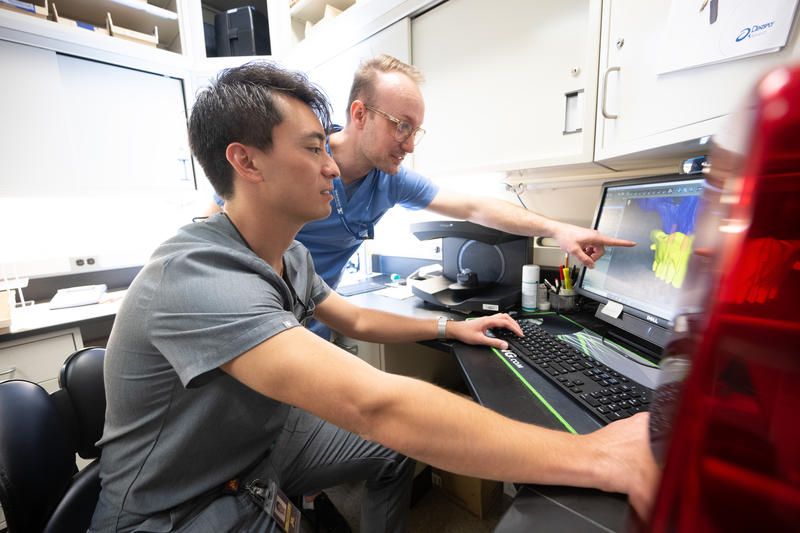
Prosthodontics residents Zane Clark and Tyson Merrill work with the 3D printer in the prosthodontics clinic.

Master of Science in Dentistry

The MS in Dentistry program is designed to prepare dentists for leadership positions in education, research, and program administration that will complement their areas of clinical expertise. The program is open to students who are or will be enrolled in one of the School of Dentistry’s participating clinical residency programs.

Overview

Housed in the University of Minnesota School of Dentistry and taught by our multidisciplinary graduate faculty, the Master of Science in Dentistry prepares students for positions in education, research and program administration. Core elements of the program include coursework in teaching and evaluation, research methods and biostatistics and program administration. 

The MS in Dentistry allows learners to develop skills in designing and conducting research, teaching, administration of clinical and educational programs and advanced multidisciplinary clinical care. Students develop an individualized schedule and program that accommodates their specific areas of interests, with the help of an advisor. 

The MS in Dentistry program is committed to providing equal access to educational opportunities in order to promote a diverse student body that enriches education by providing a multiplicity of views and perspectives.

Program at a Glance

18
Months (minimum)
MS
Degree Offered

Learn more about the program

Expand all

Apply

The MS in Dentistry only accepts applicants who are or will be enrolled in one of the School of Dentistry’s participating clinical residency programs. Applications are reviewed throughout the year, and students may enter the program in any semester at the discretion of the faculty.

Admission is granted through the Graduate School. An undergraduate GPA of 3.0 is the preferred performance level. 

Applicants must have received a DDS or DMD degree from an accredited US institution or comparable degree from recognized foreign colleges or universities. Application requirements include a CV or resume and a personal statement of 500 words or less. 

International applicants must demonstrate English language proficiency through one of the methods accepted by the Graduate School.

Please note that Graduate School English proficiency requirements reflect the minimum operational standards for admission to Graduate School. Individual clinical residency programs may have additional requirements.

Curriculum

The MS in Dentistry requires a minimum of 18 months of study, either with or without a thesis. Students will complete a minimum of 14 credits in the major, including in dental education, basic research methodology, introductory biostatistics and fundamentals of health care administration. 

Students will complete a related field or minor option of at least 6 credits and either complete a thesis or take an additional 10 credits of coursework and submit 3 papers.

MS in Dentistry Program Goals & Student Handbook

MS in Dentistry Student Handbook | 2025-2026


Program Goals & Learning Outcomes

The Master of Science in Dentistry program at the University of Minnesota prepares students for positions in education, research, and program administration that will complement their areas of clinical expertise. Core elements of the program include coursework in teaching and evaluation, research methods, biostatistics, and program administration.

The program allows learners to develop skills in designing and conducting research, teaching, administration of clinical and educational programs, and advanced multidisciplinary clinical care. Students develop an individualized schedule and program that accommodates their specific areas of interests, with the help of an advisor.

Students will typically complete the Master of Science in Dentistry program while being enrolled in one of the School of Dentistry’s participating clinical residency or fellowship programs. The program is committed to providing equal access to educational opportunities to promote a diverse student body that enriches education by providing a multiplicity of views and perspectives.

1 - Educational Goals & Outcomes

The Master of Science in Dentistry program offers training designed to prepare dentists in advanced education programs with an increased breadth and depth of knowledge about science and dentistry and to provide expertise for positions of leadership in education, research, and program administration in the oral health field. Graduates will typically obtain jobs in private practice, healthcare organizations, academic institutions, and/or government agencies, using skills and knowledge to shape policy or business decisions. They may conduct research, teach, evaluate programs, analyze data, provide patient care, and/or manage organizations. Regardless of the setting, an essential skill is the ability to construct and communicate analytical arguments as well as qualitative and quantitative information.

In addition to acquiring specific skills, a graduate of the Master of Science in Dentistry program communicates effectively with laypersons as well as dentists, physicians, and other healthcare providers in both written and oral communications. Graduates of the program collaborate effectively with diverse individuals and, increasingly, with both interdisciplinary and multidisciplinary teams.

Graduates will have the ability to make an original contribution to the scientific literature in a specialty area of dentistry. They will be able to raise a research question and design a methodology that addresses a well-defined problem. Desired outcomes for graduates include:

  • Knowledge of a specialty area of dentistry
  • Proficiency in the use of quantitative methods and research design
  • Acquisition of data management skills – proficiency is desired, but not necessary
  • Knowledge of the general operations of the healthcare system
  • Development of management skills
  • The ability to make an original research contribution to the field of dentistry
  • The ability to effectively communicate an argument and quantitative information both orally and in writing
  • Commitment to the ethical conduct of research and professional activities
2 - Assessment of Achievement of Educational Goals and Outcomes

A graduate of the Master of Science in Dentistry Program:

  • Demonstrates knowledge of a specialty area of dentistry by acquiring at least 12 credits in one of the following topic areas: Endodontics, Hospital-Special Care Dentistry, Oral Health Services for Older Adults, Orthodontics, Periodontology, Prosthodontics, or TMD, Orofacial Pain and Dental Sleep Medicine.
  • Demonstrates proficiency in the use of quantitative methods and research design by passing the core courses Biostatistical Literacy and Methods in Research and Writing with a grade of B or better in each course.
  • Demonstrates acquisition of data management skills by passing the core course Biostatistical Literacy with a grade of B or better.
  • Demonstrates knowledge of the general operations of the healthcare system by passing the core course Principles of Management in Health Services Organizations or The Health Care System and Public Health with a grade of B or better.
  • Demonstrates development of management skills by passing the core course Principles of Management in Health Services Organizations with a grade of B or better.
  • Demonstrates the ability to make an original research contribution to the field of dentistry by writing a successful Plan A or three Plan B papers
  • Demonstrates the ability to effectively communicate an argument and quantitative information both orally and in writing by writing a thesis (Plan A) or three papers (Plan B) and successfully defending the written work before an examining committee.
  • Shows commitment to the ethical conduct of research and professional activities by completing training related to Good Clinical Practice and Human Research Protections or other training as noted by their advanced training program.

Developing and transforming students into scholars is supported by a series of seminar classes taken by graduate students beginning in the first year of the program. The first-year core courses (Methods in Research and Writing and Teaching for Learning in Dentistry) familiarize students with important topics such as choosing an advisor, selecting a research question, writing a research proposal, designing a curriculum, and delivering a lecture. In addition, students often have opportunities to teach class lectures or course sections. In the context of research laboratories, they are often provided with opportunities to help mentor undergraduate or professional students conducting research projects.

The second-year core courses (Biostatistical Literacy and Principles of Management in Health Services Organizations or The Health Care System and Public Health) familiarize students with quantitative methods, data management, and the management and operations of healthcare organizations.

In addition, students undertake a research project under the guidance and supervision of a faculty advisor. Measures of success of this process include successful completion of a thesis or research papers by the students. Presentation of research by students in seminars and at regional and national conferences provides professional experience in communicating their research and provides feedback to the program on its success in creating scholars. Active participation of students in departmental research seminars and on departmental committees provides evidence of student engagement in the intellectual community and creates opportunities for students to contribute as peers. Lastly, students should seek additional formal and informal assessment, including regular discussions with their faculty advisor(s), committee members, collaborators, and peers.

3 - Reporting Outcomes

The Master of Science in Dentistry program will use the following measures of student learning performance:

  • The percentage of a student cohort that pass the core courses with a grade of B or better – the higher the percentage, the better.
  • The mean grade point average (GPA) in the core courses in each student cohort – the higher the GPA, the better. A GPA in core courses below 3.0 is not acceptable.
  • The percentage of a student cohort that successfully defends their thesis (Plan A) or three papers (Plan B) – the higher the percentage, the better.
4 - Plan for Reviews and Updates

The Director of Graduate Studies (DGS) will initiate a review of program goals and learning outcomes if requested by any member of the program graduate faculty. If the program graduate faculty deem appropriate, they will introduce new, or adjust existing, goals and outcome measurements, and document those changes in this Program Goals and Learning Outcomes document.

Summary

The overall outcome of a student completing the Master of Science in Dentistry program is expected to be a clinician-scientist who can think creatively and independently, generate new ideas, solve difficult problems, and communicate their findings and knowledge in both written and oral formats. Such a person should be able to contribute to society no matter whether their career is in private practice, academia, the public sector, or elsewhere.

Approved by faculty vote on November 1, 2024

Current Faculty

Current MS in Dentistry faculty are listed on the Graduate Education Faculty website.

Application, Renewal and Dismissal of MS in Dentistry Graduate Faculty

Introduction

Faculty may apply for an appointment to the Master of Science in Dentistry Graduate Faculty, which grants them the ability to serve in various graduate education roles: Primary Advisor, Co-advisor, Chair, Reviewer and Committee Member. The Advisory and Examination Committee Membership: Eligibility Requirements policy goes into detail on eligibility. Appointments to the Master of Science in Dentistry Graduate Faculty are granted for a term of three years.

Faculty who retire from the University of Minnesota relinquish their Graduate Faculty status upon retirement; however, they may choose to complete outstanding examining committee and advising assignments on file with the University at the point of retirement. A graduate program may appoint Emeritus Faculty where such status serves the educational interests of the program and its graduate students.

Applications

Individuals interested in serving as Graduate Faculty should follow the following process:

  1. Submit a brief letter or email requesting appointment to the Master of Science in Dentistry Graduate Education Faculty, specifying the desired graduate faculty roles (Primary Adviser, Co-adviser, Exam Committee Chair, Reviewer, Serve on Committee).
  2. Provide a current Curriculum Vitae.
  3. Submit a letter of nomination from a current member of the Master of Science in Dentistry Graduate Education faculty, highlighting how the applicant meets the following criteria:
    • Attainment of academic or professional degree(s) from accredited institution(s) at a level appropriate to guide and support the work of Master of Science in Dentistry students.
    • Experience in research and scholarship sufficient to guide and support Master of Science in Dentistry students (e.g., serving as principal investigator or co-investigator on research/scholarly projects, peer-reviewed publications, funded research grants).
    • Training or experience in teaching and/or mentoring students in research or scholarly projects.
    • Completion of appropriate training required by the University of Minnesota's Institutional Review Board (IRB) for all investigators and research personnel.
    • Any other relevant evidence that supports the applicant's capacity to teach, advise, or otherwise support graduate students in the Master of Science in Dentistry program.
  4. The application will be reviewed by the Director of Graduate Studies and, if approved, will go to the entire Master of Science in Dentistry faculty for a vote.

Renewal

Graduate Faculty appointments are renewed every three years. The purpose of the triennial renewal is to ensure members are still active and contributing to the high quality of the program. When it is time for renewal, the Master of Science in Dentistry Graduate Program Coordinator will reach out to the faculty member to confirm their interest in continuing their appointment. If the faculty has remained in good standing with the program over the previous three years, the Director of Graduate Studies will review the faculty member's qualifications and make a determination regarding renewal for an additional three-year term.

All Graduate Faculty, regardless of graduate education role, should be actively engaged in the research, education, and outreach missions of the program. Participation in at least some of the program activities, such as advising/co-advising students or serving on committees, is expected in order to remain in good standing in the program.

Dismissal

A faculty member may be dismissed from the Master of Science in Dentistry Graduate Faculty for cause on grounds including but not limited to intellectual dishonesty; acts of discrimination, including harassment, prohibited by law or University policy; acts of moral turpitude substantially related to the fitness of faculty members to engage in teaching, research, service/outreach and/or administration in the program; theft or misuse of University property; use of professional authority to exploit others; violation of University policy substantially related to performance of Master of Science in Dentistry Graduate Faculty responsibilities; and violation of law(s) substantially related to the fitness of faculty members to engage in teaching, research, service/outreach and/or administration. The final determination as to whether a faculty should be dismissed shall be made by an ad hoc committee consisting of the Directors of Graduate Studies of the Graduate Programs housed in the School of Dentistry.

Contact

For questions about these process guidelines, reach out to the following personnel:

GRAD 999

GRAD 999 is a zero-credit, zero-tuition registration option intended for graduate students who have completed all coursework and (if applicable) thesis credit requirements, and who must maintain registration to meet the registration requirement. GRAD 999 enrollment serves only to maintain active student status.

Master's students may register for GRAD 999 once (one semester) without requesting college permission. Doctoral students may register for GRAD 999 twice (two semesters) without requesting college permission. For these initial registrations, consult with your graduate program coordinator for access to register.

To receive permission to register for GRAD 999 beyond these limits, you must submit the GRAD 999 Registration Request form and document the circumstances that necessitate additional semesters of GRAD 999 registration. GRAD 999 registration is not guaranteed in a given semester until final approval from the Assistant Dean for Advanced Education has been received.

Program Director

Thorsten Gruenheid at courtyard garden near Moos Tower in 2023

Thorsten Gruenheid, DDS, PhD, MPH, MHA

Assistant Dean for Advanced Education
Department of Developmental and Surgical Sciences,
Division of Orthodontics

Contact Us

Email our program at [email protected].